


Does IPL has DLS Method: Yes, the Indian Premier League uses the DLS(Duckworth-Lewis-Stern) method in rain-affected matches since the first season.
The DLS method is used to adjust scores when rain or weather interruptions affect the progress of a match. This system is widely adopted in limited-overs cricket formats, including T20s and One-Day Internationals (ODIs), to ensure fair results.
What is DLS Method?
The Duckworth-Lewis-Stern (DLS) method is a mathematical formula used to calculate the revised target score in rain-affected cricket matches. It takes into account:
- Overs remaining
- Wickets lost
- The scoring potential of the team at any given moment
This method ensures both teams have a fair chance despite the loss of overs due to rain or other interruptions.
Difference between Par Score and Target Score
Par score is the total that a chasing team should have reached – when they are ‘X’ wickets down – at the time of interruption while the target score is the revised score that a team is required to get after an interruption.
The target score is one fixed number, while the par score changes according to the number of wickets lost. The par scores are calculated before an interruption, while targets are calculated after an interruption.
How Does DLS Work in the IPL?
Here’s how the DLS method is applied during IPL matches:
1. First Innings Progresses Normally
- The team batting first sets a target in 20 overs.
2. Rain Interrupts Second Innings
- If rain interrupts the second innings:
- The number of overs left is reduced
- The target score for the chasing team is recalculated using the DLS formula
- The updated score is displayed on screen and announced by officials
3. Minimum Overs Rule
- In IPL and all T20 matches:
- At least 5 overs must be bowled in the second innings for the match to have a result using DLS.
- If not possible, the match may be abandoned or rescheduled, depending on the tournament rules.
When Was the DLS Method First Used in the IPL?
The Duckworth-Lewis-Stern (DLS) method was first used in the Indian Premier League (IPL) during the Kolkata Knight Riders vs Kings XI Punjab match in the 2009 season played on 26 April 2009 in South Africa.
How DLS is Calculated?
To calculate a target, the formula may simply be expressed as:
Team 2’s par score = Team 1’s score x (Team 2’s resources/Team 1’s resources).
During the match after the interruption, there are only two factors remain with the team for the calculation of this method.
Every team available with these two resources namely:
- Remaining Overs
- Remaining Wickets
On the basis of these two resources, Frank Duckworth and Tony Lewis have prepared a chart which suggests that how many resources are left with the batting side in different situations.
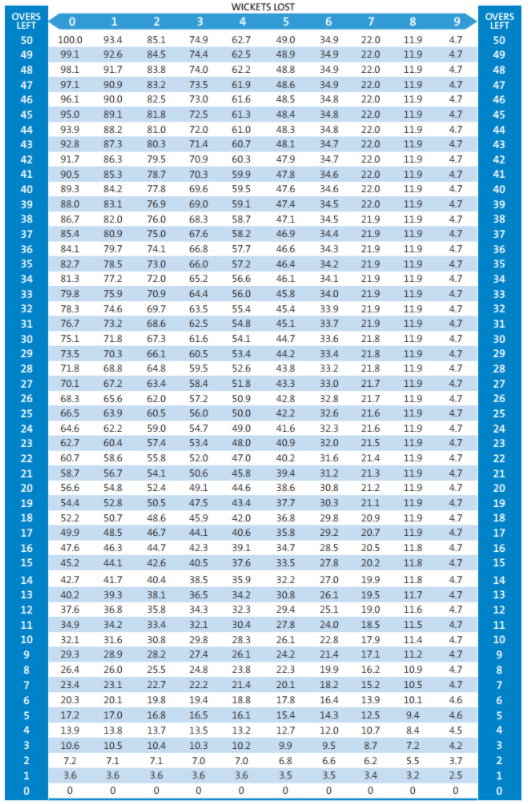
Real-time Example of a DLS Method Calculation:
Let us take an example that happens earlier before in DLS history where India beats Australia by 26 runs. This happens in the first ODI of Australia tour of India in Septem
- In the 1st innings, India scored 7/281 in 50 overs.
- During the innings break, rain interrupts play, and the match is reduced to 21 overs.
- The 2nd innings commences, with Australia requiring 164 for victory.
- Australia finishes their innings on 9/137 off 21 overs.
- India wins by 26 runs on the D/L Method.

