


AUS vs IND 1st T20I DLS Par Score: The match between Australia and India, played on October 29 at Manuka Oval, has been interrupted by rain.
The rain stopped the play during the 5th over of India’s innings, where they scored 43 runs for a wicket.
The DLS par score will be calculated only if the match when rain or another factor interrupts a limited-over cricket match forcing a revision of the target score for the team batting second.
AUS vs IND 1st T20I DLS Par Score
After being invited to bat first, Abhishek Sharma and Shubman Gill went on to open the innings while Josh Hazlewood opened the bowling attack.
Abhishek Sharma and Gill provided a solid start, scoring 35 runs for the first wicket. Nathan Ellis provided the first breakthrough dismissing Abhishek Sharma for 19 runs before rain interrupted the game.
- At 2:15 PM IST, the drizzle got heavier and the umpire called for covers and the ground staff reacted quickly bringing the covers.
- At 02:38 PM IST, the drizzle stopped and the cover are coming off.
- The rain eventually stopped and the match is set to begin at 03:00 PM IST and will be 18-over per side game.
The match resumed and India went on to score 97 runs in the 10th over before rain once again picked up the pace.
- At 3:23 PM IST, the rain once started to pour and got heavier and we are going to lose more overs.
- At 3:57 PM IST, the intensity of the rain has reduced, but it’s still drizzling. The square is under covers as the game continues to lose overs.
- At 04:10 PM IST, it is still raining and we have only few time left for 5-over game. If India won’t bat again, it will be a 5 over contest and Australia’s DLS target will be 71.
- At 04:27 PM IST, the rain did not seemed to ease and the game has been called off.
How is DLS calculated?
To calculate a target, the formula may simply be expressed as:
Team 2’s par score = Team 1’s score x (Team 2’s resources/Team 1’s resources).
During the match after the interruption, there are only two factors remain with the team for the calculation of this method.
Every team available with these two resources namely:
- Remaining Overs
- Remaining Wickets
On the basis of these two resources, Frank Duckworth and Tony Lewis have prepared a chart which suggests that how many resources are left with the batting side in different situations.
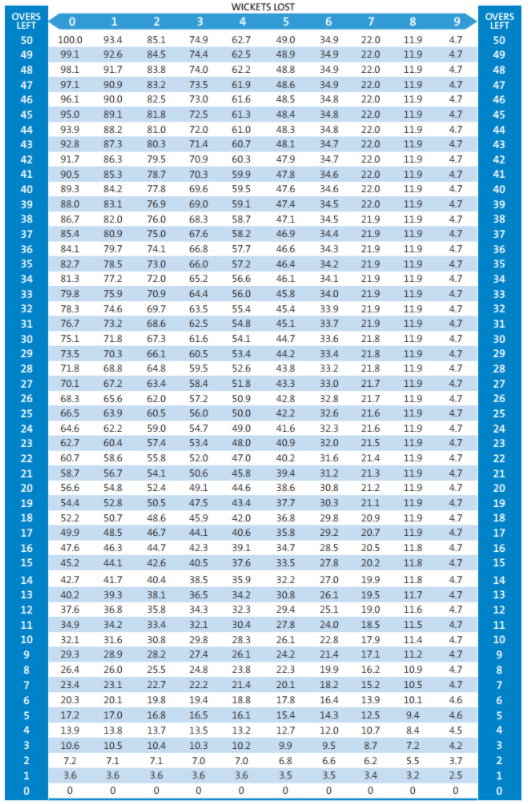
Real-time Example of a DLS Method Calculation:
Let us take an example that happens earlier before in DLS history where India beats Australia by 26 runs. This happens in the first ODI of Australia tour of India in September.
- In the 1st innings, India scored 7/281 in 50 overs.
- During the innings break, rain interrupts play, and the match is reduced to 21 overs.
- The 2nd innings commences, with Australia requiring 164 for victory.
- Australia finishes their innings on 9/137 off 21 overs.
- India wins by 26 runs on the D/L Method.
WATCH: How DLS Method is Calculated in Cricket By ICC

